

 |
 |
 |
 |
 |
 |
 |
Here you can see the first soccer balls which were used in the first World Cup until the most recent championships in which the sport brand ADIDAS is the official supplier. All these balls are original and they are not on sale.
Official World Cup Balls:
 |
BALL FROM XIX CENTURY (1800-1850) During the 19th Century many sports with ball became popular (Soccer/ football, rugby, basket...etc). At the beginning the same ball was used for all these sports. It did not matter the ball's feature for every sport. This model was the most used for all sports from 1800-1850 to 1900. His appearance is almost identical to one of basketball. This model is available in our Store. |
 |
BALL OF THE BEGINNING OF XX CENTURY (1900) This model was the first one known on the soccer history. Its appearance was like a basket ball. The ball was consisted of 8 long panels which joined in two poles of the ball thanks to an octagon panel, as you can see. Of course this model was not use in any World Cup but it is interesting to know how the first soccer balls were like. Available in store. |
 |
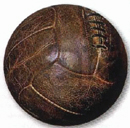
1930 T- SHAPE The T-Shape model was used on the first World Cup in Uruguay 1930. It was characterized by the T form of its panels. There were in total 12 T panels. This ball had a sewing with lace to be inflated as you can observe on the picture. On the 1930 championship were used two ball models, the T-Shape and the 12 panels ball (the following model). Available at store. |
 |
1930 TWELVE PANELS This mythical ball consisted of 12 panels made of genuine leather. This model and the T-Shape ball were used during the first World Cup in 1930, Uruguay. It had a sewing with laces out the ball in order to inflate it. This ball has gone down in history as the icon ball in most of clubs' shields like Barcelona's shield. It represents all ancient leather balls from 1930 to 1960. Available at store. |
 |
1934 FEDERALE 102 Model used on the 2º World Cup, Italy 1934. It consisted of 13 cut panels. Nowadays it is so difficult to find a model of this time. The ball also had a sewing with lace to be inflated. Available at store. |
 |
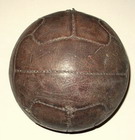
1938 ALLEN This ball was known as ALLEN, the company which provided soccer balls during the World Cup in France 1938. These kind of balls usually had 12 panels but this model consisted of 13 leather panels, because on the part of the ball where had the lace to be inflated, was consisted of 3 panels. The rest of the ball consisted of groups of 2 panels. Available at store. |
 |
1950 SUPER DUPLO T Ball used on the 50´s and of course on the World Cup in Brasil 1950. It consisted of 12 panels. This model was the first one which did not have any sewing with lace, that is to say, it was inflated as the current balls, thanks to a valve. Available at store. |
 |
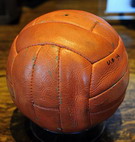
1954 SWISS The official ball on the Switzerland World Cup 1954. It was consisted of 18 leather cut panels. The reason of using cut panels was because the goal was to get the most espherical ball as possible. This ball also was the first one in a different colour, yellow. On its surface was printed with the following lettering: SWISS WORLD CHAMPION MATCH BALL. Available at store. |
 |
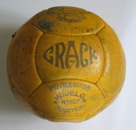
1958 TOP START Ball used on The World Cup in Sweden 1958. The design was very similar to 1954 model, but in this case the panels was not cut as you can see. It was consisted of 18 leather panels. For this tournament were used two ball models, one brown, one white. The white model was used on the last matches, but not on the final. Available at store. |
 |
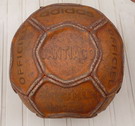
1962 CRACK The legendary Crack ball was the authentic ball used during the 1962 World Cup in Chile. This mode revolutionized the soccer balls designs due to its octogonal panels. This ball was composed of octogonal long panels. Curiosly this is the Adidas stile at the present days, using long panels to get more ball's surface in order to kick it in a better way. This model had a bladder as the current balls. Available at store. |
 |
1963 SANTIAGO Many people think the Santiago ball was the official ball for the 1962 World Cup in Chile, but it was not. Adidas, the brand which designed the Santiago, launched this model in 1963 as a tribute to the World Cup played last year. In the 90's Adidas relaunched a reedition of this ball, the Santiago. |
 |
1966 CHALLENGE This model was well-known as "Challenge". It was used on The World Cup in England 1966. Model very similar like 1958 one, the most important difference was the colour, orange. Although during the championship were also used in yellow and white. This model was the last one before the ADIDAS hegemony. From that moment on the following World Cup models were designed by ADIDAS. Available at store. |
 |
1970 TELSTAR Telstar, provided by Adidas, was the official match ball of 1970 FIFA World Cup and 1974 FIFA World Cup held in Mexico and West Germany. It was painted with black and white panels so it was more visible on black-and-white television, and hence its name which is short for television star. Telstar was also a series of TV satellites, providing intercontinental live coverage also of football games. |
 |
1974 TELSTAR Y CHILE DURLAST Adidas repeated the same design, the only difference was the colour of the lettering, in this case in black. The Telstar is considered a classic design . The Telstar became in the icon of all soccer balls that is why we can see this design in most of cartoon movies, comics or pictures for children. On the 1974 World Cup in Germany, Adidas introduced two models, the Telstar and the Chile Durlast. Both models were the official match balls for that tournament. The Chile durlast ball was composed by 32 panels as well, but the ball was completly white. |
 |
1978 TANGO RIVER PLATE Tango Durlast by Adidas was the official match ball of 1978 FIFA World Cup in Argentina.It introduced a new design which would be used for the next twenty years: Twenty identical panels with ‘triads’ created the impression of 7 circles. It was the most expensive ball in history, at the time, with a £50 price tag. Like its predecessors, the adidas tango durlast was made of genuine leather and boasted the shiny waterproofing durlast coating. |
 |
1982 TANGO ESPAÑA Tango España by Adidas was the official match ball of 1982 FIFA World Cup in Spain. The Tango España had improved water resistant qualities through its rubberized seams. These were not very resistant and resulted in the ball having to be changed several times during some games. This ball was the last genuine leather ball to be used in the world cup. |
 |
.1986 AZTECA Azteca Mexico by Adidas was the official match ball of 1986 FIFA World Cup in Mexico. It was also the first fully synthetic FIFA World Cup ball.The elaborately decorated design was inspired by the hosting nation’s native Aztec architecture and murals. |
 |
1990 ETRUSCO UNICO The Etrusco Unico was a football made by Adidas in the early 1990s. It was the official match ball of the 1990 FIFA World Cup in Italy and the Euro 1992 in Sweden. The name and intricate design took their inspiration from Italy’s ancient history and the fine art of the Etruscans. Three Etruscan lion heads decorate each of the 20 Tango triads.
|
 |
1994 QUESTRA Questra by Adidas was the official match ball of 1994 FIFA World Cup in United State. The name was derived from an ancient word meaning "the quest for the stars."In the development process of the Questra, Adidas tried to create a lighter and more responsive ball. By manufacturing the new ball from five different materials and enveloping it in polystyrene foam, Adidas made the Questra more waterproof and allowed for greater acceleration when kicked. |
 |
1998 TRICOLORE Tricolore by Adidas was the official match ball of 1998 FIFA World Cup in France. It was the first multi-coloured ball to be used in the finals. It was also the last world cup ball to bear the classic tango design introduced in 1978. The blue design was to represent the colours of the french national team who were the hosts of the world cup in 1998. Tricolores were also the first adidas world cup match-balls manufactured outside of Europe (made in Morocco) since the 1970 telstar. |
 |
2002 FEVERNOVA The adidas Fevernova was the first World Cup Match Ball since 1978 to part from the traditional Tango design introduced in 1978. The colorful and revolutionary look and color usage was entirely based on Asian culture. The Fevernova featured a refined syntactic foam layer to give the ball superior performance characteristics and a three-layer, knitted chassis, allowing for a more precise and predictable flight path every time. |
 |
2006 TEAMGEIST The ball was designed by the Adidas Innovation Team and the Molten Corporation and is made by Adidas, which has provided the balls used in all World Cup matches since the 1970 World Cup when the Telstar was introduced. The Teamgeist ball differs from previous balls in having just 14 curved panels (making the ball topologically equivalent to a truncated octahedron), rather than the 32 that have been standard since 1970. In another first, the panels are bonded together rather than stitched. It is claimed to be rounder and to perform more uniformly regardless of where it is hit, and being almost waterproof it does not change performance as much when wet. |
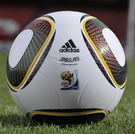 |
2010 JABULANI The official ball for the 2010 World Cup in South Africa was the Jabulani. This model like its predecessor, Teamgeist, also is composed of large panels to get the most smooth surface as possible. But technically speaking, its surface has a roughness in order to be controlled better by players. |
 |
|